Meet Salomi: The Home Chef from sanath nagar Feeding 80 Office Workers Every Morning
Meet Salomi: The Home Chef from sanath nagar Feeding 80 Office Workers Every Morning
Salomi wakes up at 5 AM every day in her sanath nagar kitchen to feed 80 strangers who've come to feel like family. This is her story — and why her food tastes like it was made for you.
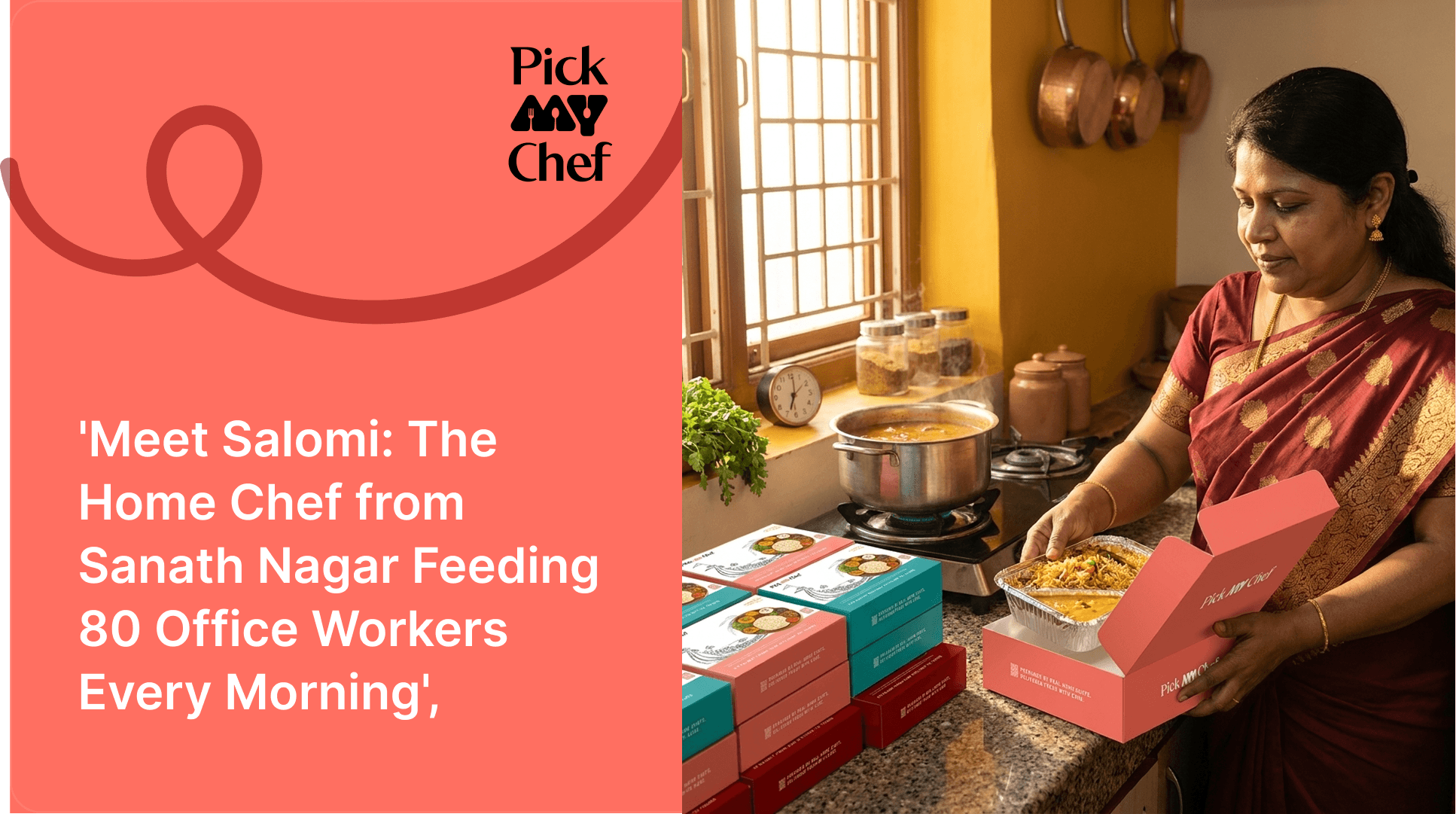
By 5:15 AM, the rest of Sanath Nagar is still asleep.
The neighbourhood is quiet — just the distant sound of an early autorickshaw and the first pigeons on the water tank overhead. But in the kitchen of a third-floor flat on Sanath Nagar Road, the gas flame is already lit. The pressure cooker is on. The smell of mustard seeds hitting hot oil drifts out under the door and into the corridor.
Salomi has been awake for twenty minutes. She'll be cooking for the next four hours.
By 9:30 AM, she will have prepared Fifty individual lunches. Each one packed, labelled, and handed to the delivery partner who arrives at her door like clockwork. By 1 PM, those eighty boxes will be sitting on eighty desks across offices in Miyapur, Kondapur, Hitech City — opened by Fifty people who have come to count on what's inside.
Most of them have never met Salomi. But many of them, when asked about their lunch, use the same word.
Amma style.
How It Started: A Lockdown, A Hobby, and One Honest Question
Salomi didn't set out to build a food business. She set out to not go quietly mad during the 2020 lockdown.
"Before COVID, I was just cooking for my family — my husband, my two sons, my mother-in-law," she says, sitting at her kitchen table, a cup of chai going cold beside her because she keeps getting up to check something on the stove. "During lockdown, I started cooking more. Trying new things. Sharing with neighbours. People kept saying — Salomi, you should do something about this."
She laughed it off the first few times. She had no professional training. She'd never worked in a restaurant. She was a homemaker who happened to cook the way her mother had taught her — carefully, with fresh ingredients, without shortcuts.
Then a colleague of her husband asked if she could pack him lunch for a week. He was working from home, tired of cooking for himself, and had eaten at their house once and not forgotten it.
She said yes. She charged him ₹120 for the week. He paid her ₹200 and told three colleagues.
That was the beginning.
The Kitchen That Feeds a Neighborhood
Salomi's kitchen is not large. It is not fitted with commercial equipment or industrial burners. It looks, in most ways, exactly like your mother's kitchen — a little worn at the edges, deeply organized, with masalas lined up in matching dabbas and a steel shelf of pressure cookers in three different sizes.
What is extraordinary about it is not the space. It is the system.
Everything is prepared in stages. Grains and lentils soaked the night before. Vegetables chopped by 5 AM. The first batch — a vegetarian thali of rice, dal, a sabzi, and rasam — goes on at 5:30 AM. The non-vegetarian batch begins at 6:15. The rotis, which she refuses to make in advance because they go hard, are rolled and cooked between 7:30 and 9 AM in a continuous, rhythmic process.
She does all of this herself, with occasional help from her younger son on busy days. She does not use a cook. She does not outsource the rotis or the rice. "If I'm not making it, I can't stand behind it," she says simply. "These people are eating this instead of cooking for themselves. That is trust. I don't want to break that."
The menu rotates weekly. Monday is always a South Indian meal — sambar, rice, a dry curry, curd. Tuesday, she does a North Indian thali. Wednesday brings a special item — sometimes a pulao, sometimes a dal khichdi on rainy days, sometimes a biryani that her regulars have been known to text her about in advance. Thursday is her personal favorite — a rasam rice that she says she could eat every day of her life. Friday is what she calls the "comfort meal" — simple, light, easy on the stomach before the weekend.
What Her Customers Actually Say
Arjun Sharma works at a logistics startup in Miyapur. He found Salomi's subscription through Pick My Chef about Four months ago, on a day when his Zomato order arrived forty minutes late, cold, and wrong.
"I just typed something like 'home cooked lunch near me' and went through a few options," he says. "I chose Salomi because the menu looked real. Not the kind of thing you get at a restaurant. Just proper ghar ka khana."
He's been subscribing ever since. He estimates he's had perhaps four meals from restaurants in those seven months.
"The thing that gets you is consistency. Every day, the food is exactly what she said it would be. It's hot. It tastes the same every time — which sounds like a small thing, but when you're eating lunch alone at your desk, that consistency feels like someone is looking out for you."
He pauses. "It sounds dramatic. But that's the truth."
Meghana Iyer, a software engineer who subscribes to Salomi's plan along with two colleagues at her firm in Hitech City, puts it differently: "I stopped thinking about lunch. And I mean that as the highest possible compliment. Lunch is just handled. It arrives, it's good, I eat it, I go back to work feeling like a human being. That used to not be the case."
The Oil Question — And Why It Matters More Than You Think
Every new subscriber asks Salomi some version of the same question eventually: how much oil do you use?
It's not a rude question. It's the right one. Restaurant food in Hyderabad — for all its wonderful flavor — is typically cooked in significantly more oil than anyone would use at home. Volume cooking demands it. Taste profiles are built for the first two bites, not the fifth hour of your workday.
Salomi's answer is always the same: "I use what I would use if I was cooking for my family. No more."
In practice, that means a measured tablespoon of oil for a sabzi, not a ladleful. It means she tempers her mustard seeds and curry leaves in a small katori, not a pool. It means the dal tastes of lentils and spices, not of the oil that's meant to carry them.
"My mother-in-law is diabetic. My husband has cholesterol concerns. I've been cooking for health for fifteen years without thinking of it as cooking for health," she says. "It was just cooking properly."
That home-calibrated relationship with oil and salt is, nutritionally speaking, one of the most significant differences between a home-cooked meal and its restaurant equivalent — and it's the thing that Sunita's subscribers notice first, usually within the second week, when the 2 PM energy crash they'd accepted as normal simply stops happening.
What It Means to Run a Kitchen Like This
Salomi earns a real income now. She is careful about exact numbers — "my husband says I shouldn't say," she laughs — but she describes it as more than she ever imagined possible from her kitchen, and more than she would earn in most entry-level jobs available to her in the neighborhood.
More than the income, though, she talks about what the work has given her sense of herself.
"Before this, if someone asked me what I do, I would say 'nothing, I'm just at home.' That used to bother me more than I admitted." She looks at the kitchen. "Now I say I run a food business. Because I do. I have customers. I have a menu. I have a system. I built this."
She joined Pick My Chef's platform about Five months ago, after a neighbor who was already on it suggested she apply. The vetting process — a kitchen inspection, a food safety review, a tasting — took two weeks. She passed without any requests for changes.
"They came and looked at my kitchen. They asked about my process, my hygiene, where I buy my vegetables from. I showed them everything. They said: you're already doing it right. We just need to connect you to more people."
Today she has eighty regular subscribers. She has turned down requests to expand further — not from lack of demand, but from a clear-eyed understanding of the line between quality and scale.
"The day I start compromising the food to fit more boxes, I will stop," she says. "That is the rule I made for myself. Fifty is the number where I can still be in control of everything. Fifty is where the food is still mine."
The Thing About Cooking for Strangers
There is a moment in every morning, Sunita says, somewhere around 8 AM when the rotis are going and the dabbas are lined up waiting to be filled, that she thinks about the people who will open them a few hours later.
She doesn't know most of them. She knows some names, a few preferences,the occasional message of thanks that comes through the app. She knows that one subscriber always requests no onion. She knows that three of the KPHB group asked her once, tentatively, if she could do a lighter Friday meal because they were all trying to eat less before the weekend.
She adjusted the Friday menu the following week. She didn't charge extra. She didn't announce it.
They noticed. They sent a message.
"When I imagine someone opening the box and it's exactly what they needed — not just food, but the right food, made properly, on a hard day — that is the feeling I cook for," she says. "It has nothing to do with a restaurant. The restaurant doesn't know you. I'm not a restaurant. I'm the person who made your lunch this morning."
She stands up to check something on the stove. The chai is cold now. The kitchen smells of today's Wednesday special — a chicken Biryani that is already, at 10 AM, filling the corridor outside.
Fifty people are going to be very happy at lunch.
Salomi is a verified home chef on the Pick My Chef platform, serving Kukatpally, KPHB, and Nizampet. To subscribe to her meal plan or discover home chefs near your office in Hyderabad, visit pickmychef.com.
Meet Salomi: The Home Chef from sanath nagar Feeding 80 Office Workers Every Morning
Salomi wakes up at 5 AM every day in her sanath nagar kitchen to feed 80 strangers who've come to feel like family. This is her story — and why her food tastes like it was made for you.
By 5:15 AM, the rest of Sanath Nagar is still asleep.
The neighbourhood is quiet — just the distant sound of an early autorickshaw and the first pigeons on the water tank overhead. But in the kitchen of a third-floor flat on Sanath Nagar Road, the gas flame is already lit. The pressure cooker is on. The smell of mustard seeds hitting hot oil drifts out under the door and into the corridor.
Salomi has been awake for twenty minutes. She'll be cooking for the next four hours.
By 9:30 AM, she will have prepared Fifty individual lunches. Each one packed, labelled, and handed to the delivery partner who arrives at her door like clockwork. By 1 PM, those eighty boxes will be sitting on eighty desks across offices in Miyapur, Kondapur, Hitech City — opened by Fifty people who have come to count on what's inside.
Most of them have never met Salomi. But many of them, when asked about their lunch, use the same word.
Amma style.
How It Started: A Lockdown, A Hobby, and One Honest Question
Salomi didn't set out to build a food business. She set out to not go quietly mad during the 2020 lockdown.
"Before COVID, I was just cooking for my family — my husband, my two sons, my mother-in-law," she says, sitting at her kitchen table, a cup of chai going cold beside her because she keeps getting up to check something on the stove. "During lockdown, I started cooking more. Trying new things. Sharing with neighbours. People kept saying — Salomi, you should do something about this."
She laughed it off the first few times. She had no professional training. She'd never worked in a restaurant. She was a homemaker who happened to cook the way her mother had taught her — carefully, with fresh ingredients, without shortcuts.
Then a colleague of her husband asked if she could pack him lunch for a week. He was working from home, tired of cooking for himself, and had eaten at their house once and not forgotten it.
She said yes. She charged him ₹120 for the week. He paid her ₹200 and told three colleagues.
That was the beginning.
The Kitchen That Feeds a Neighborhood
Salomi's kitchen is not large. It is not fitted with commercial equipment or industrial burners. It looks, in most ways, exactly like your mother's kitchen — a little worn at the edges, deeply organized, with masalas lined up in matching dabbas and a steel shelf of pressure cookers in three different sizes.
What is extraordinary about it is not the space. It is the system.
Everything is prepared in stages. Grains and lentils soaked the night before. Vegetables chopped by 5 AM. The first batch — a vegetarian thali of rice, dal, a sabzi, and rasam — goes on at 5:30 AM. The non-vegetarian batch begins at 6:15. The rotis, which she refuses to make in advance because they go hard, are rolled and cooked between 7:30 and 9 AM in a continuous, rhythmic process.
She does all of this herself, with occasional help from her younger son on busy days. She does not use a cook. She does not outsource the rotis or the rice. "If I'm not making it, I can't stand behind it," she says simply. "These people are eating this instead of cooking for themselves. That is trust. I don't want to break that."
The menu rotates weekly. Monday is always a South Indian meal — sambar, rice, a dry curry, curd. Tuesday, she does a North Indian thali. Wednesday brings a special item — sometimes a pulao, sometimes a dal khichdi on rainy days, sometimes a biryani that her regulars have been known to text her about in advance. Thursday is her personal favorite — a rasam rice that she says she could eat every day of her life. Friday is what she calls the "comfort meal" — simple, light, easy on the stomach before the weekend.
What Her Customers Actually Say
Arjun Sharma works at a logistics startup in Miyapur. He found Salomi's subscription through Pick My Chef about Four months ago, on a day when his Zomato order arrived forty minutes late, cold, and wrong.
"I just typed something like 'home cooked lunch near me' and went through a few options," he says. "I chose Salomi because the menu looked real. Not the kind of thing you get at a restaurant. Just proper ghar ka khana."
He's been subscribing ever since. He estimates he's had perhaps four meals from restaurants in those seven months.
"The thing that gets you is consistency. Every day, the food is exactly what she said it would be. It's hot. It tastes the same every time — which sounds like a small thing, but when you're eating lunch alone at your desk, that consistency feels like someone is looking out for you."
He pauses. "It sounds dramatic. But that's the truth."
Meghana Iyer, a software engineer who subscribes to Salomi's plan along with two colleagues at her firm in Hitech City, puts it differently: "I stopped thinking about lunch. And I mean that as the highest possible compliment. Lunch is just handled. It arrives, it's good, I eat it, I go back to work feeling like a human being. That used to not be the case."
The Oil Question — And Why It Matters More Than You Think
Every new subscriber asks Salomi some version of the same question eventually: how much oil do you use?
It's not a rude question. It's the right one. Restaurant food in Hyderabad — for all its wonderful flavor — is typically cooked in significantly more oil than anyone would use at home. Volume cooking demands it. Taste profiles are built for the first two bites, not the fifth hour of your workday.
Salomi's answer is always the same: "I use what I would use if I was cooking for my family. No more."
In practice, that means a measured tablespoon of oil for a sabzi, not a ladleful. It means she tempers her mustard seeds and curry leaves in a small katori, not a pool. It means the dal tastes of lentils and spices, not of the oil that's meant to carry them.
"My mother-in-law is diabetic. My husband has cholesterol concerns. I've been cooking for health for fifteen years without thinking of it as cooking for health," she says. "It was just cooking properly."
That home-calibrated relationship with oil and salt is, nutritionally speaking, one of the most significant differences between a home-cooked meal and its restaurant equivalent — and it's the thing that Sunita's subscribers notice first, usually within the second week, when the 2 PM energy crash they'd accepted as normal simply stops happening.
What It Means to Run a Kitchen Like This
Salomi earns a real income now. She is careful about exact numbers — "my husband says I shouldn't say," she laughs — but she describes it as more than she ever imagined possible from her kitchen, and more than she would earn in most entry-level jobs available to her in the neighborhood.
More than the income, though, she talks about what the work has given her sense of herself.
"Before this, if someone asked me what I do, I would say 'nothing, I'm just at home.' That used to bother me more than I admitted." She looks at the kitchen. "Now I say I run a food business. Because I do. I have customers. I have a menu. I have a system. I built this."
She joined Pick My Chef's platform about Five months ago, after a neighbor who was already on it suggested she apply. The vetting process — a kitchen inspection, a food safety review, a tasting — took two weeks. She passed without any requests for changes.
"They came and looked at my kitchen. They asked about my process, my hygiene, where I buy my vegetables from. I showed them everything. They said: you're already doing it right. We just need to connect you to more people."
Today she has eighty regular subscribers. She has turned down requests to expand further — not from lack of demand, but from a clear-eyed understanding of the line between quality and scale.
"The day I start compromising the food to fit more boxes, I will stop," she says. "That is the rule I made for myself. Fifty is the number where I can still be in control of everything. Fifty is where the food is still mine."
The Thing About Cooking for Strangers
There is a moment in every morning, Sunita says, somewhere around 8 AM when the rotis are going and the dabbas are lined up waiting to be filled, that she thinks about the people who will open them a few hours later.
She doesn't know most of them. She knows some names, a few preferences,the occasional message of thanks that comes through the app. She knows that one subscriber always requests no onion. She knows that three of the KPHB group asked her once, tentatively, if she could do a lighter Friday meal because they were all trying to eat less before the weekend.
She adjusted the Friday menu the following week. She didn't charge extra. She didn't announce it.
They noticed. They sent a message.
"When I imagine someone opening the box and it's exactly what they needed — not just food, but the right food, made properly, on a hard day — that is the feeling I cook for," she says. "It has nothing to do with a restaurant. The restaurant doesn't know you. I'm not a restaurant. I'm the person who made your lunch this morning."
She stands up to check something on the stove. The chai is cold now. The kitchen smells of today's Wednesday special — a chicken Biryani that is already, at 10 AM, filling the corridor outside.
Fifty people are going to be very happy at lunch.
Salomi is a verified home chef on the Pick My Chef platform, serving Kukatpally, KPHB, and Nizampet. To subscribe to her meal plan or discover home chefs near your office in Hyderabad, visit pickmychef.com.
Meet Salomi: The Home Chef from sanath nagar Feeding 80 Office Workers Every Morning
Salomi wakes up at 5 AM every day in her sanath nagar kitchen to feed 80 strangers who've come to feel like family. This is her story — and why her food tastes like it was made for you.
By 5:15 AM, the rest of Sanath Nagar is still asleep.
The neighbourhood is quiet — just the distant sound of an early autorickshaw and the first pigeons on the water tank overhead. But in the kitchen of a third-floor flat on Sanath Nagar Road, the gas flame is already lit. The pressure cooker is on. The smell of mustard seeds hitting hot oil drifts out under the door and into the corridor.
Salomi has been awake for twenty minutes. She'll be cooking for the next four hours.
By 9:30 AM, she will have prepared Fifty individual lunches. Each one packed, labelled, and handed to the delivery partner who arrives at her door like clockwork. By 1 PM, those eighty boxes will be sitting on eighty desks across offices in Miyapur, Kondapur, Hitech City — opened by Fifty people who have come to count on what's inside.
Most of them have never met Salomi. But many of them, when asked about their lunch, use the same word.
Amma style.
How It Started: A Lockdown, A Hobby, and One Honest Question
Salomi didn't set out to build a food business. She set out to not go quietly mad during the 2020 lockdown.
"Before COVID, I was just cooking for my family — my husband, my two sons, my mother-in-law," she says, sitting at her kitchen table, a cup of chai going cold beside her because she keeps getting up to check something on the stove. "During lockdown, I started cooking more. Trying new things. Sharing with neighbours. People kept saying — Salomi, you should do something about this."
She laughed it off the first few times. She had no professional training. She'd never worked in a restaurant. She was a homemaker who happened to cook the way her mother had taught her — carefully, with fresh ingredients, without shortcuts.
Then a colleague of her husband asked if she could pack him lunch for a week. He was working from home, tired of cooking for himself, and had eaten at their house once and not forgotten it.
She said yes. She charged him ₹120 for the week. He paid her ₹200 and told three colleagues.
That was the beginning.
The Kitchen That Feeds a Neighborhood
Salomi's kitchen is not large. It is not fitted with commercial equipment or industrial burners. It looks, in most ways, exactly like your mother's kitchen — a little worn at the edges, deeply organized, with masalas lined up in matching dabbas and a steel shelf of pressure cookers in three different sizes.
What is extraordinary about it is not the space. It is the system.
Everything is prepared in stages. Grains and lentils soaked the night before. Vegetables chopped by 5 AM. The first batch — a vegetarian thali of rice, dal, a sabzi, and rasam — goes on at 5:30 AM. The non-vegetarian batch begins at 6:15. The rotis, which she refuses to make in advance because they go hard, are rolled and cooked between 7:30 and 9 AM in a continuous, rhythmic process.
She does all of this herself, with occasional help from her younger son on busy days. She does not use a cook. She does not outsource the rotis or the rice. "If I'm not making it, I can't stand behind it," she says simply. "These people are eating this instead of cooking for themselves. That is trust. I don't want to break that."
The menu rotates weekly. Monday is always a South Indian meal — sambar, rice, a dry curry, curd. Tuesday, she does a North Indian thali. Wednesday brings a special item — sometimes a pulao, sometimes a dal khichdi on rainy days, sometimes a biryani that her regulars have been known to text her about in advance. Thursday is her personal favorite — a rasam rice that she says she could eat every day of her life. Friday is what she calls the "comfort meal" — simple, light, easy on the stomach before the weekend.
What Her Customers Actually Say
Arjun Sharma works at a logistics startup in Miyapur. He found Salomi's subscription through Pick My Chef about Four months ago, on a day when his Zomato order arrived forty minutes late, cold, and wrong.
"I just typed something like 'home cooked lunch near me' and went through a few options," he says. "I chose Salomi because the menu looked real. Not the kind of thing you get at a restaurant. Just proper ghar ka khana."
He's been subscribing ever since. He estimates he's had perhaps four meals from restaurants in those seven months.
"The thing that gets you is consistency. Every day, the food is exactly what she said it would be. It's hot. It tastes the same every time — which sounds like a small thing, but when you're eating lunch alone at your desk, that consistency feels like someone is looking out for you."
He pauses. "It sounds dramatic. But that's the truth."
Meghana Iyer, a software engineer who subscribes to Salomi's plan along with two colleagues at her firm in Hitech City, puts it differently: "I stopped thinking about lunch. And I mean that as the highest possible compliment. Lunch is just handled. It arrives, it's good, I eat it, I go back to work feeling like a human being. That used to not be the case."
The Oil Question — And Why It Matters More Than You Think
Every new subscriber asks Salomi some version of the same question eventually: how much oil do you use?
It's not a rude question. It's the right one. Restaurant food in Hyderabad — for all its wonderful flavor — is typically cooked in significantly more oil than anyone would use at home. Volume cooking demands it. Taste profiles are built for the first two bites, not the fifth hour of your workday.
Salomi's answer is always the same: "I use what I would use if I was cooking for my family. No more."
In practice, that means a measured tablespoon of oil for a sabzi, not a ladleful. It means she tempers her mustard seeds and curry leaves in a small katori, not a pool. It means the dal tastes of lentils and spices, not of the oil that's meant to carry them.
"My mother-in-law is diabetic. My husband has cholesterol concerns. I've been cooking for health for fifteen years without thinking of it as cooking for health," she says. "It was just cooking properly."
That home-calibrated relationship with oil and salt is, nutritionally speaking, one of the most significant differences between a home-cooked meal and its restaurant equivalent — and it's the thing that Sunita's subscribers notice first, usually within the second week, when the 2 PM energy crash they'd accepted as normal simply stops happening.
What It Means to Run a Kitchen Like This
Salomi earns a real income now. She is careful about exact numbers — "my husband says I shouldn't say," she laughs — but she describes it as more than she ever imagined possible from her kitchen, and more than she would earn in most entry-level jobs available to her in the neighborhood.
More than the income, though, she talks about what the work has given her sense of herself.
"Before this, if someone asked me what I do, I would say 'nothing, I'm just at home.' That used to bother me more than I admitted." She looks at the kitchen. "Now I say I run a food business. Because I do. I have customers. I have a menu. I have a system. I built this."
She joined Pick My Chef's platform about Five months ago, after a neighbor who was already on it suggested she apply. The vetting process — a kitchen inspection, a food safety review, a tasting — took two weeks. She passed without any requests for changes.
"They came and looked at my kitchen. They asked about my process, my hygiene, where I buy my vegetables from. I showed them everything. They said: you're already doing it right. We just need to connect you to more people."
Today she has eighty regular subscribers. She has turned down requests to expand further — not from lack of demand, but from a clear-eyed understanding of the line between quality and scale.
"The day I start compromising the food to fit more boxes, I will stop," she says. "That is the rule I made for myself. Fifty is the number where I can still be in control of everything. Fifty is where the food is still mine."
The Thing About Cooking for Strangers
There is a moment in every morning, Sunita says, somewhere around 8 AM when the rotis are going and the dabbas are lined up waiting to be filled, that she thinks about the people who will open them a few hours later.
She doesn't know most of them. She knows some names, a few preferences,the occasional message of thanks that comes through the app. She knows that one subscriber always requests no onion. She knows that three of the KPHB group asked her once, tentatively, if she could do a lighter Friday meal because they were all trying to eat less before the weekend.
She adjusted the Friday menu the following week. She didn't charge extra. She didn't announce it.
They noticed. They sent a message.
"When I imagine someone opening the box and it's exactly what they needed — not just food, but the right food, made properly, on a hard day — that is the feeling I cook for," she says. "It has nothing to do with a restaurant. The restaurant doesn't know you. I'm not a restaurant. I'm the person who made your lunch this morning."
She stands up to check something on the stove. The chai is cold now. The kitchen smells of today's Wednesday special — a chicken Biryani that is already, at 10 AM, filling the corridor outside.
Fifty people are going to be very happy at lunch.
Salomi is a verified home chef on the Pick My Chef platform, serving Kukatpally, KPHB, and Nizampet. To subscribe to her meal plan or discover home chefs near your office in Hyderabad, visit pickmychef.com.
Get App