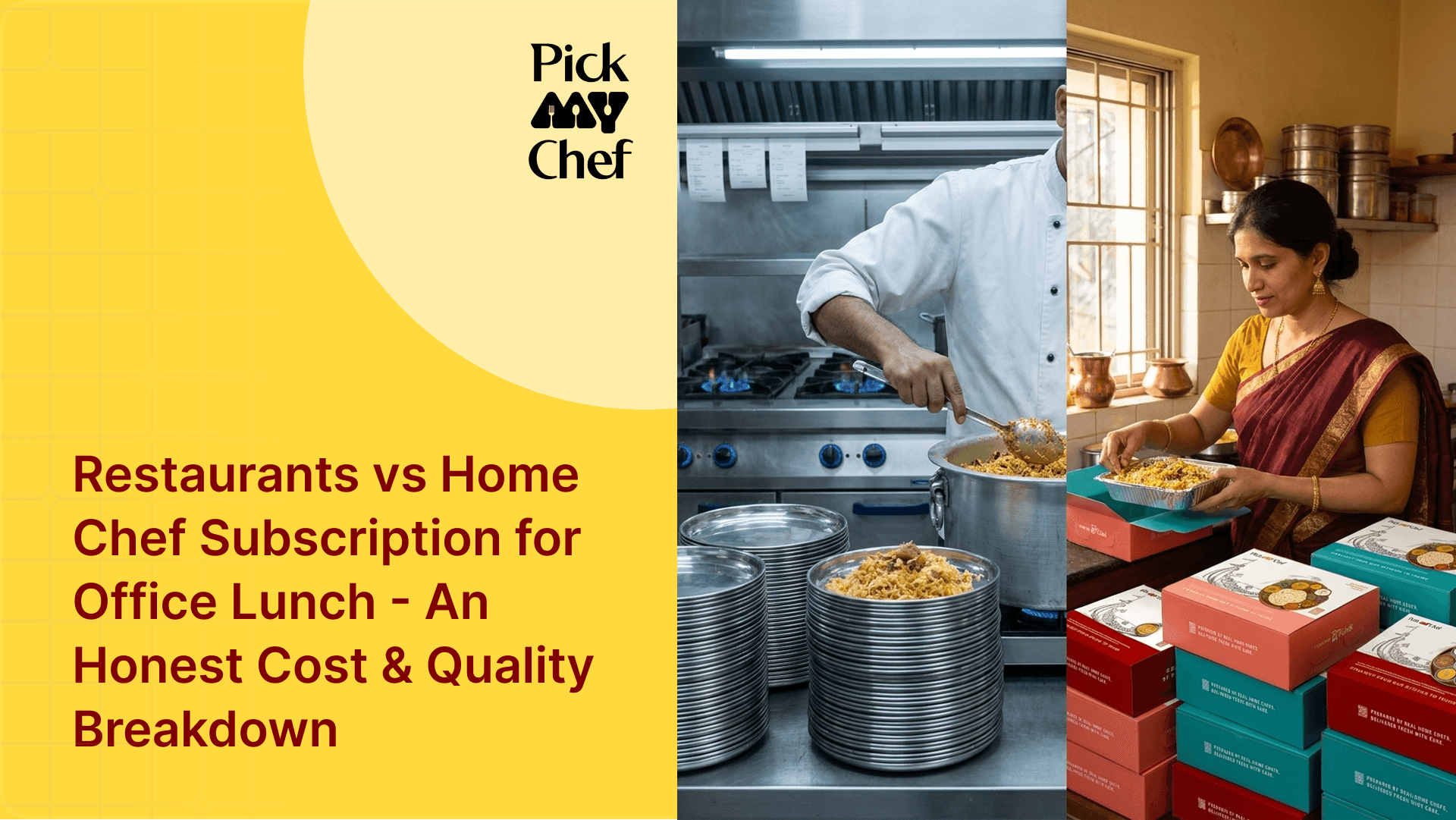
Restaurants vs Home Chef Subscription for Office Lunch — An Honest Cost & Quality Breakdown
Restaurants vs Home Chef Subscription for Office Lunch — An Honest Cost & Quality Breakdown
Zomato or a home chef subscription — which one makes sense for your daily office lunch in Hyderabad? We break down the real cost, food quality, and hidden tradeoffs of both, honestly.
Deepa made the switch on a Tuesday.
Not because of a health revelation or a productivity hack she'd read about. She switched because her Zomato order arrived 52 minutes late, cold, and missing the raita she had specifically added to the cart. It was the third time that month. She had a meeting in eight minutes and was eating lukewarm paneer butter masala straight from a foil container at her desk in Kondapur.
That evening she looked up for home chef subscriptions in Hyderabad. Within the week, she had cancelled her lunch delivery habit and signed up for a meal plan.
Six months later, she says she thinks about lunch approximately zero times per workday. The box arrives. She eats. She goes back to work feeling like a person.
This piece is for everyone who has had a version of Deepa's Tuesday. We're going to do what most food content refuses to do: put restaurants and home chef subscriptions side by side. Honestly, across every dimension that matters for a working professional eating lunch at a desk in Hyderabad.
What We Are Actually Comparing
To be precise about what's on the table here — we are comparing two specific habits, not two categories of food.
Order from restaurants via Zomato, Swiggy, or direct hotel delivery for your office lunch, five days a week. This includes the biryanis, the thalis, the paneer curries, the fried rice combos — whatever you currently order from whichever apps are open on your phone at 12:30 PM.
Subscribing to a home chef meal plan - through a platform like Pick My Chef — where a vetted, FSSAI-registered home cook prepares your lunch fresh every morning and has it delivered to your office before noon. Menus rotate weekly. Plans start at ₹99 per meal.
Both are delivery-based. Both bring food to your desk. Everything else is different.
Round 1: The Real Cost
What you think you spend on restaurant delivery
Most people who order lunch through a delivery app genuinely do not know what they spend monthly. They see individual orders — ₹220 here, ₹180 there — and the number feels manageable. It is not.
A realistic restaurant delivery lunch in Hyderabad in 2026 looks like this:
Base meal cost: ₹150–₹220
Platform fee (Zomato/Swiggy): ₹25–₹50
Delivery charge (varies by distance and time): ₹30–₹60
Surge pricing on peak lunch hours: ₹20–₹40
GST on restaurant food and platform fees: ₹15–₹30
A single "₹180 lunch" routinely lands between ₹280 and ₹380 in your cart total. Multiply that by 22 working days. A conservative estimate for a single person eating at restaurant delivery for lunch every workday in Hyderabad: ₹6,160 to ₹8,360 per month.
Now consider how often the order arrives late, wrong, or cold — and that number represents food that frequently does not even deliver on its promise.
What you spend on a home chef subscription
Pick My Chef's meal plans are priced at the point of subscription, with no platform fees, no delivery surge, no GST surprises:
Budget Box: ₹99/meal
Standard Box: ₹130–₹150/meal
Premium Box: ₹175–₹200/meal
Over 22 working days on the Standard plan: ₹2,860 to ₹3,300 per month.
The monthly saving for one person: ₹3,300 to ₹5,060.
For a team of 10, that is ₹33,000 to ₹50,600 in monthly savings — enough to fund a meaningful employee benefit, not just lunch.
The cost comparison briefly
| Restaurant Delivery | Home Chef Subscription |
Average daily cost | ₹280–₹380 | ₹99–₹200 |
Monthly cost (22 days) | ₹6,160–₹8,360 | ₹2,178–₹4,400 |
Price transparency | Low (fees added at checkout) | High (all-inclusive) |
Minimum order | Per order | Subscription (flexible) |
Cost on WFH days | Full price | Pause with notice |
The restaurant wins on nothing in this row. The only counterargument is variety — and we will get to that.
Round 2: Food Quality
This is where the comparison gets more nuanced — and where most food delivery marketing is deliberately dishonest.
What restaurant delivery food is
Restaurant food, when eaten fresh at the restaurant, is often excellent. That is not what you get when you order delivery.
What you are getting is food that was cooked in bulk — sometimes hours before your order was placed — reheated in a commercial kitchen when the order came through, packaged in foil or plastic containers designed to hold heat for transit, and then carried across Hyderabad traffic by a delivery partner who has three other orders on the same run.
By the time it reaches your desk, the food has been through a journey that it was not really designed for. The texture has changed. The oil has been separated. The rice has set. The curry, if it is a thin one, has become a sauce in a puddle. The roti, if there is one, has turned to cardboard.
This is the honest reality of restaurant delivery food — not restaurant food.
The specific problems for daily office eating:
Refined oils at scale. Restaurant kitchens serving hundreds of covers a day use large quantities of refined vegetable oil because it is cheap and handles bulk cooking well. As covered in our earlier piece on what restaurant food does to your body over time, this daily dose of omega-6 heavy refined oil accumulates in ways that show up as inflammation, fatigue, and digestive disruption over weeks and months.
High sodium. Restaurant food is seasoned for impact — for the customer eating in, who needs to be impressed in the first two bites. The salt levels are calibrated for satisfaction, not for health. A typical restaurant lunch can contain your entire recommended daily sodium intake in a single meal, leaving your kidneys and your blood pressure working harder than they need to all afternoon.
Refined carbohydrates. White rice, naan, Maida-based breads — these are the structural base of most restaurant lunch orders. They digest rapidly, spike blood sugar, and reliably produce the 2 PM crash that has become the defining feature of office afternoons across Hyderabad's IT corridors.
What home chef food actually is
A home chef on the Pick My Chef platform wakes up early. She soaks her grains the night before. She buys her vegetables from the local market that morning. She cooks in the quantities a home kitchen is designed for — twenty, thirty, forty portions — using the amount of oil she would use if she was feeding her own family. Because in a very real sense, she is.
The result lands on your desk with a texture and a warmth that is genuinely different from restaurant delivery. The dal has a body to it. The sabzi has not been sitting under a lamp for two hours. The roti, packed separately and still flexible, tastes like someone made it this morning.
Because someone did it.
The specific advantages for daily office eating:
Measured oil and salt. Home cooks, cooking in home quantities, use home-calibrated amounts of oil and salt. Not the industrial volumes required by a commercial kitchen managing hundreds of orders. This single difference — less refined oil, less sodium — is responsible for most of the "I don't crash at 2 PM anymore" feedback that home chef subscribers report within the first two to three weeks.
Whole ingredients cooked fresh. Home kitchens do not pre-prepare in bulk and reheat. The food that arrives at your desk was prepared within the last three to four hours. The proteins are cooked once. The vegetables retain more of their nutrition. The flavours are the flavors of the ingredients, not of the cooking process that was designed to survive a 45-minute delivery window.
Rotating, intentional menus. Pick My Chef's menus rotate weekly — South Indian on Monday, North Indian on Tuesday, a special item mid-week, lighter options towards the weekend. This is not an accidental variety. It is structured nutrition that provides dietary balance across the week, something no single restaurant can offer by definition.
Round 3: Reliability
Ask anyone who orders lunch through delivery apps regularly, and they will tell you, unprompted, about the failures. The 50-minute wait that made them miss the start of a meeting. The order marked delivered that never arrived. The substitution they didn't agree with. The restaurant cancelled 20 minutes after acceptance with no explanation.
This is not unique to one platform or one city. It is structural. Delivery apps are optimized for volume and speed at a macro level. Individual orders are managed by algorithms, not by people who know you or care about your 1 PM meeting.
A home chef subscription operates differently. Your order is placed in advance — typically the day before or on a weekly schedule. The chef knows exactly how many boxes she is preparing. The delivery is routed efficiently because it is not a one-off order competing with hundreds of others for a delivery partner. The food arrives in a predictable window, every day, without the anxiety of looking at a map and wondering if your biryani will make it before your next call.
Reliability is not a minor quality of life feature. For a working professional, the certainty of knowing lunch is handled — truly handled, not hoping-the-algorithm-works handled — is worth something that does not show up in a cost comparison table.
Round 4: Customization and Dietary Needs
What restaurants offer
On a delivery app, customization means choosing between a handful of add-ons and removing items from a fixed menu. You can ask for "less spicy." You can request no onion. What you cannot do is ask a restaurant to cook with less oil, to use whole wheat instead of Maida, to reduce the portion of rice and increase the protein, or to swap the curry for something that fits your pre-diabetic meal plan.
Restaurant menus are fixed for operational reasons. They cannot personalise at the individual level across hundreds of daily orders.
What a home chef subscription offers
Pick My Chef's platform allows dietary preferences per subscriber — vegetarian or non-vegetarian, standard or low-calorie, high-protein, South Indian or North Indian preference, spice level. For corporate team subscriptions, each team member can have different preferences within the same daily order.
Over time, as the chef-subscriber relationship develops, further customisation becomes possible. Salomi, one of Pick My Chef's home chefs in Sanath Nagar, knows that one of her subscribers cannot have an onion. She knows another prefers lighter Friday meals. She adjusted without being asked twice.
This level of personalization does not exist in the restaurant delivery model. It cannot — not at scale, not with algorithms.
Round 5: The Experience of Eating It
This is the dimension that cost tables cannot capture, but which matters more than most people admit to themselves.
Restaurant delivery of food is designed to be transactional. Order, receive, consume, rate, repeat. The food is fine. It is predictable. It is, after a while, boring in a way that makes you feel slightly worse about lunch even before you've opened the box.
Home chef food has a quality that is genuinely hard to articulate without sounding sentimental — but here it is anyway: it tastes like it was made for you. Not for a thousand people, some of whom might be you. For you, specifically, today.
The flavors are slightly different each week because the chef adjusts for what is fresh. The rasam on a cold December morning is a little warmer than the August version. Friday Khichdi has a lightness to it that feels like someone thought about how you were going to feel at the end of the week.
This is not mysticism. It is the natural consequence of a human being cooking in small quantities with care and knowledge, rather than a commercial kitchen optimising for throughput.
For people eating alone at their desks — which describes a large portion of Hyderabad's IT workforce on any given lunchtime — that quality of feeling looked after is not trivial. Food is not only fuel. It is one of the few points in a working day that can feel genuinely nourishing, in the fullest sense of the word.
Where Restaurants Still Win
Honesty requires this section.
Variety on demand If you want Japanese food today, Thai tomorrow, and a Hyderabadi biryani on Friday, no home chef subscription can offer that range. Delivery apps have access to hundreds of restaurants across every cuisine. The home chef model offers depth within a cuisine — excellent home-style Indian cooking — not breadth across cuisines. If variety is your primary criterion, delivery apps win.
Occasion ordering For a birthday lunch, a team celebration, or any meal where the food is the centrepiece of an event rather than the fuel for an afternoon, a restaurant — with its presentation, its range, its capacity for something special — is the right choice.
No commitment required An app order takes 90 seconds. A subscription requires setup, a decision about plan tier, a weekly menu commitment. For people who are deeply irregular in their office attendance or who genuinely enjoy the daily decision of choosing their lunch, the friction of a subscription is a real downside.
The Honest Verdict
If you eat lunch at your desk in a Hyderabad office four or five days a week, the restaurant delivery model is costing you roughly twice what a home chef subscription costs — for food that is less fresh, less healthy, less reliable, and less personal.
The restaurant delivery habit persists not because it is the better option, but because it is the path of least resistance. The app is already installed. The decision is made now of hunger. The subscription requires a small act of forethought that most people haven't gotten around to.
Deepa's Tuesday was that forethought. Six months later, she does not think about lunch.
That is, genuinely, what good food is supposed to feel like.
Pick My Chef home chef meal subscriptions start at ₹150/meal for Hyderabad offices, with weekly rotating menus, and flexible pause options. Individual and corporate team plans available across HITECH City, Gachibowli, Kondapur, Madhapur, KPHB, and surrounding areas. Visit pickmychef.com.
Restaurants vs Home Chef Subscription for Office Lunch — An Honest Cost & Quality Breakdown
Zomato or a home chef subscription — which one makes sense for your daily office lunch in Hyderabad? We break down the real cost, food quality, and hidden tradeoffs of both, honestly.
Deepa made the switch on a Tuesday.
Not because of a health revelation or a productivity hack she'd read about. She switched because her Zomato order arrived 52 minutes late, cold, and missing the raita she had specifically added to the cart. It was the third time that month. She had a meeting in eight minutes and was eating lukewarm paneer butter masala straight from a foil container at her desk in Kondapur.
That evening she looked up for home chef subscriptions in Hyderabad. Within the week, she had cancelled her lunch delivery habit and signed up for a meal plan.
Six months later, she says she thinks about lunch approximately zero times per workday. The box arrives. She eats. She goes back to work feeling like a person.
This piece is for everyone who has had a version of Deepa's Tuesday. We're going to do what most food content refuses to do: put restaurants and home chef subscriptions side by side. Honestly, across every dimension that matters for a working professional eating lunch at a desk in Hyderabad.
What We Are Actually Comparing
To be precise about what's on the table here — we are comparing two specific habits, not two categories of food.
Order from restaurants via Zomato, Swiggy, or direct hotel delivery for your office lunch, five days a week. This includes the biryanis, the thalis, the paneer curries, the fried rice combos — whatever you currently order from whichever apps are open on your phone at 12:30 PM.
Subscribing to a home chef meal plan - through a platform like Pick My Chef — where a vetted, FSSAI-registered home cook prepares your lunch fresh every morning and has it delivered to your office before noon. Menus rotate weekly. Plans start at ₹99 per meal.
Both are delivery-based. Both bring food to your desk. Everything else is different.
Round 1: The Real Cost
What you think you spend on restaurant delivery
Most people who order lunch through a delivery app genuinely do not know what they spend monthly. They see individual orders — ₹220 here, ₹180 there — and the number feels manageable. It is not.
A realistic restaurant delivery lunch in Hyderabad in 2026 looks like this:
Base meal cost: ₹150–₹220
Platform fee (Zomato/Swiggy): ₹25–₹50
Delivery charge (varies by distance and time): ₹30–₹60
Surge pricing on peak lunch hours: ₹20–₹40
GST on restaurant food and platform fees: ₹15–₹30
A single "₹180 lunch" routinely lands between ₹280 and ₹380 in your cart total. Multiply that by 22 working days. A conservative estimate for a single person eating at restaurant delivery for lunch every workday in Hyderabad: ₹6,160 to ₹8,360 per month.
Now consider how often the order arrives late, wrong, or cold — and that number represents food that frequently does not even deliver on its promise.
What you spend on a home chef subscription
Pick My Chef's meal plans are priced at the point of subscription, with no platform fees, no delivery surge, no GST surprises:
Budget Box: ₹99/meal
Standard Box: ₹130–₹150/meal
Premium Box: ₹175–₹200/meal
Over 22 working days on the Standard plan: ₹2,860 to ₹3,300 per month.
The monthly saving for one person: ₹3,300 to ₹5,060.
For a team of 10, that is ₹33,000 to ₹50,600 in monthly savings — enough to fund a meaningful employee benefit, not just lunch.
The cost comparison briefly
| Restaurant Delivery | Home Chef Subscription |
Average daily cost | ₹280–₹380 | ₹99–₹200 |
Monthly cost (22 days) | ₹6,160–₹8,360 | ₹2,178–₹4,400 |
Price transparency | Low (fees added at checkout) | High (all-inclusive) |
Minimum order | Per order | Subscription (flexible) |
Cost on WFH days | Full price | Pause with notice |
The restaurant wins on nothing in this row. The only counterargument is variety — and we will get to that.
Round 2: Food Quality
This is where the comparison gets more nuanced — and where most food delivery marketing is deliberately dishonest.
What restaurant delivery food is
Restaurant food, when eaten fresh at the restaurant, is often excellent. That is not what you get when you order delivery.
What you are getting is food that was cooked in bulk — sometimes hours before your order was placed — reheated in a commercial kitchen when the order came through, packaged in foil or plastic containers designed to hold heat for transit, and then carried across Hyderabad traffic by a delivery partner who has three other orders on the same run.
By the time it reaches your desk, the food has been through a journey that it was not really designed for. The texture has changed. The oil has been separated. The rice has set. The curry, if it is a thin one, has become a sauce in a puddle. The roti, if there is one, has turned to cardboard.
This is the honest reality of restaurant delivery food — not restaurant food.
The specific problems for daily office eating:
Refined oils at scale. Restaurant kitchens serving hundreds of covers a day use large quantities of refined vegetable oil because it is cheap and handles bulk cooking well. As covered in our earlier piece on what restaurant food does to your body over time, this daily dose of omega-6 heavy refined oil accumulates in ways that show up as inflammation, fatigue, and digestive disruption over weeks and months.
High sodium. Restaurant food is seasoned for impact — for the customer eating in, who needs to be impressed in the first two bites. The salt levels are calibrated for satisfaction, not for health. A typical restaurant lunch can contain your entire recommended daily sodium intake in a single meal, leaving your kidneys and your blood pressure working harder than they need to all afternoon.
Refined carbohydrates. White rice, naan, Maida-based breads — these are the structural base of most restaurant lunch orders. They digest rapidly, spike blood sugar, and reliably produce the 2 PM crash that has become the defining feature of office afternoons across Hyderabad's IT corridors.
What home chef food actually is
A home chef on the Pick My Chef platform wakes up early. She soaks her grains the night before. She buys her vegetables from the local market that morning. She cooks in the quantities a home kitchen is designed for — twenty, thirty, forty portions — using the amount of oil she would use if she was feeding her own family. Because in a very real sense, she is.
The result lands on your desk with a texture and a warmth that is genuinely different from restaurant delivery. The dal has a body to it. The sabzi has not been sitting under a lamp for two hours. The roti, packed separately and still flexible, tastes like someone made it this morning.
Because someone did it.
The specific advantages for daily office eating:
Measured oil and salt. Home cooks, cooking in home quantities, use home-calibrated amounts of oil and salt. Not the industrial volumes required by a commercial kitchen managing hundreds of orders. This single difference — less refined oil, less sodium — is responsible for most of the "I don't crash at 2 PM anymore" feedback that home chef subscribers report within the first two to three weeks.
Whole ingredients cooked fresh. Home kitchens do not pre-prepare in bulk and reheat. The food that arrives at your desk was prepared within the last three to four hours. The proteins are cooked once. The vegetables retain more of their nutrition. The flavours are the flavors of the ingredients, not of the cooking process that was designed to survive a 45-minute delivery window.
Rotating, intentional menus. Pick My Chef's menus rotate weekly — South Indian on Monday, North Indian on Tuesday, a special item mid-week, lighter options towards the weekend. This is not an accidental variety. It is structured nutrition that provides dietary balance across the week, something no single restaurant can offer by definition.
Round 3: Reliability
Ask anyone who orders lunch through delivery apps regularly, and they will tell you, unprompted, about the failures. The 50-minute wait that made them miss the start of a meeting. The order marked delivered that never arrived. The substitution they didn't agree with. The restaurant cancelled 20 minutes after acceptance with no explanation.
This is not unique to one platform or one city. It is structural. Delivery apps are optimized for volume and speed at a macro level. Individual orders are managed by algorithms, not by people who know you or care about your 1 PM meeting.
A home chef subscription operates differently. Your order is placed in advance — typically the day before or on a weekly schedule. The chef knows exactly how many boxes she is preparing. The delivery is routed efficiently because it is not a one-off order competing with hundreds of others for a delivery partner. The food arrives in a predictable window, every day, without the anxiety of looking at a map and wondering if your biryani will make it before your next call.
Reliability is not a minor quality of life feature. For a working professional, the certainty of knowing lunch is handled — truly handled, not hoping-the-algorithm-works handled — is worth something that does not show up in a cost comparison table.
Round 4: Customization and Dietary Needs
What restaurants offer
On a delivery app, customization means choosing between a handful of add-ons and removing items from a fixed menu. You can ask for "less spicy." You can request no onion. What you cannot do is ask a restaurant to cook with less oil, to use whole wheat instead of Maida, to reduce the portion of rice and increase the protein, or to swap the curry for something that fits your pre-diabetic meal plan.
Restaurant menus are fixed for operational reasons. They cannot personalise at the individual level across hundreds of daily orders.
What a home chef subscription offers
Pick My Chef's platform allows dietary preferences per subscriber — vegetarian or non-vegetarian, standard or low-calorie, high-protein, South Indian or North Indian preference, spice level. For corporate team subscriptions, each team member can have different preferences within the same daily order.
Over time, as the chef-subscriber relationship develops, further customisation becomes possible. Salomi, one of Pick My Chef's home chefs in Sanath Nagar, knows that one of her subscribers cannot have an onion. She knows another prefers lighter Friday meals. She adjusted without being asked twice.
This level of personalization does not exist in the restaurant delivery model. It cannot — not at scale, not with algorithms.
Round 5: The Experience of Eating It
This is the dimension that cost tables cannot capture, but which matters more than most people admit to themselves.
Restaurant delivery of food is designed to be transactional. Order, receive, consume, rate, repeat. The food is fine. It is predictable. It is, after a while, boring in a way that makes you feel slightly worse about lunch even before you've opened the box.
Home chef food has a quality that is genuinely hard to articulate without sounding sentimental — but here it is anyway: it tastes like it was made for you. Not for a thousand people, some of whom might be you. For you, specifically, today.
The flavors are slightly different each week because the chef adjusts for what is fresh. The rasam on a cold December morning is a little warmer than the August version. Friday Khichdi has a lightness to it that feels like someone thought about how you were going to feel at the end of the week.
This is not mysticism. It is the natural consequence of a human being cooking in small quantities with care and knowledge, rather than a commercial kitchen optimising for throughput.
For people eating alone at their desks — which describes a large portion of Hyderabad's IT workforce on any given lunchtime — that quality of feeling looked after is not trivial. Food is not only fuel. It is one of the few points in a working day that can feel genuinely nourishing, in the fullest sense of the word.
Where Restaurants Still Win
Honesty requires this section.
Variety on demand If you want Japanese food today, Thai tomorrow, and a Hyderabadi biryani on Friday, no home chef subscription can offer that range. Delivery apps have access to hundreds of restaurants across every cuisine. The home chef model offers depth within a cuisine — excellent home-style Indian cooking — not breadth across cuisines. If variety is your primary criterion, delivery apps win.
Occasion ordering For a birthday lunch, a team celebration, or any meal where the food is the centrepiece of an event rather than the fuel for an afternoon, a restaurant — with its presentation, its range, its capacity for something special — is the right choice.
No commitment required An app order takes 90 seconds. A subscription requires setup, a decision about plan tier, a weekly menu commitment. For people who are deeply irregular in their office attendance or who genuinely enjoy the daily decision of choosing their lunch, the friction of a subscription is a real downside.
The Honest Verdict
If you eat lunch at your desk in a Hyderabad office four or five days a week, the restaurant delivery model is costing you roughly twice what a home chef subscription costs — for food that is less fresh, less healthy, less reliable, and less personal.
The restaurant delivery habit persists not because it is the better option, but because it is the path of least resistance. The app is already installed. The decision is made now of hunger. The subscription requires a small act of forethought that most people haven't gotten around to.
Deepa's Tuesday was that forethought. Six months later, she does not think about lunch.
That is, genuinely, what good food is supposed to feel like.
Pick My Chef home chef meal subscriptions start at ₹150/meal for Hyderabad offices, with weekly rotating menus, and flexible pause options. Individual and corporate team plans available across HITECH City, Gachibowli, Kondapur, Madhapur, KPHB, and surrounding areas. Visit pickmychef.com.
Restaurants vs Home Chef Subscription for Office Lunch — An Honest Cost & Quality Breakdown
Zomato or a home chef subscription — which one makes sense for your daily office lunch in Hyderabad? We break down the real cost, food quality, and hidden tradeoffs of both, honestly.
Deepa made the switch on a Tuesday.
Not because of a health revelation or a productivity hack she'd read about. She switched because her Zomato order arrived 52 minutes late, cold, and missing the raita she had specifically added to the cart. It was the third time that month. She had a meeting in eight minutes and was eating lukewarm paneer butter masala straight from a foil container at her desk in Kondapur.
That evening she looked up for home chef subscriptions in Hyderabad. Within the week, she had cancelled her lunch delivery habit and signed up for a meal plan.
Six months later, she says she thinks about lunch approximately zero times per workday. The box arrives. She eats. She goes back to work feeling like a person.
This piece is for everyone who has had a version of Deepa's Tuesday. We're going to do what most food content refuses to do: put restaurants and home chef subscriptions side by side. Honestly, across every dimension that matters for a working professional eating lunch at a desk in Hyderabad.
What We Are Actually Comparing
To be precise about what's on the table here — we are comparing two specific habits, not two categories of food.
Order from restaurants via Zomato, Swiggy, or direct hotel delivery for your office lunch, five days a week. This includes the biryanis, the thalis, the paneer curries, the fried rice combos — whatever you currently order from whichever apps are open on your phone at 12:30 PM.
Subscribing to a home chef meal plan - through a platform like Pick My Chef — where a vetted, FSSAI-registered home cook prepares your lunch fresh every morning and has it delivered to your office before noon. Menus rotate weekly. Plans start at ₹99 per meal.
Both are delivery-based. Both bring food to your desk. Everything else is different.
Round 1: The Real Cost
What you think you spend on restaurant delivery
Most people who order lunch through a delivery app genuinely do not know what they spend monthly. They see individual orders — ₹220 here, ₹180 there — and the number feels manageable. It is not.
A realistic restaurant delivery lunch in Hyderabad in 2026 looks like this:
Base meal cost: ₹150–₹220
Platform fee (Zomato/Swiggy): ₹25–₹50
Delivery charge (varies by distance and time): ₹30–₹60
Surge pricing on peak lunch hours: ₹20–₹40
GST on restaurant food and platform fees: ₹15–₹30
A single "₹180 lunch" routinely lands between ₹280 and ₹380 in your cart total. Multiply that by 22 working days. A conservative estimate for a single person eating at restaurant delivery for lunch every workday in Hyderabad: ₹6,160 to ₹8,360 per month.
Now consider how often the order arrives late, wrong, or cold — and that number represents food that frequently does not even deliver on its promise.
What you spend on a home chef subscription
Pick My Chef's meal plans are priced at the point of subscription, with no platform fees, no delivery surge, no GST surprises:
Budget Box: ₹99/meal
Standard Box: ₹130–₹150/meal
Premium Box: ₹175–₹200/meal
Over 22 working days on the Standard plan: ₹2,860 to ₹3,300 per month.
The monthly saving for one person: ₹3,300 to ₹5,060.
For a team of 10, that is ₹33,000 to ₹50,600 in monthly savings — enough to fund a meaningful employee benefit, not just lunch.
The cost comparison briefly
| Restaurant Delivery | Home Chef Subscription |
Average daily cost | ₹280–₹380 | ₹99–₹200 |
Monthly cost (22 days) | ₹6,160–₹8,360 | ₹2,178–₹4,400 |
Price transparency | Low (fees added at checkout) | High (all-inclusive) |
Minimum order | Per order | Subscription (flexible) |
Cost on WFH days | Full price | Pause with notice |
The restaurant wins on nothing in this row. The only counterargument is variety — and we will get to that.
Round 2: Food Quality
This is where the comparison gets more nuanced — and where most food delivery marketing is deliberately dishonest.
What restaurant delivery food is
Restaurant food, when eaten fresh at the restaurant, is often excellent. That is not what you get when you order delivery.
What you are getting is food that was cooked in bulk — sometimes hours before your order was placed — reheated in a commercial kitchen when the order came through, packaged in foil or plastic containers designed to hold heat for transit, and then carried across Hyderabad traffic by a delivery partner who has three other orders on the same run.
By the time it reaches your desk, the food has been through a journey that it was not really designed for. The texture has changed. The oil has been separated. The rice has set. The curry, if it is a thin one, has become a sauce in a puddle. The roti, if there is one, has turned to cardboard.
This is the honest reality of restaurant delivery food — not restaurant food.
The specific problems for daily office eating:
Refined oils at scale. Restaurant kitchens serving hundreds of covers a day use large quantities of refined vegetable oil because it is cheap and handles bulk cooking well. As covered in our earlier piece on what restaurant food does to your body over time, this daily dose of omega-6 heavy refined oil accumulates in ways that show up as inflammation, fatigue, and digestive disruption over weeks and months.
High sodium. Restaurant food is seasoned for impact — for the customer eating in, who needs to be impressed in the first two bites. The salt levels are calibrated for satisfaction, not for health. A typical restaurant lunch can contain your entire recommended daily sodium intake in a single meal, leaving your kidneys and your blood pressure working harder than they need to all afternoon.
Refined carbohydrates. White rice, naan, Maida-based breads — these are the structural base of most restaurant lunch orders. They digest rapidly, spike blood sugar, and reliably produce the 2 PM crash that has become the defining feature of office afternoons across Hyderabad's IT corridors.
What home chef food actually is
A home chef on the Pick My Chef platform wakes up early. She soaks her grains the night before. She buys her vegetables from the local market that morning. She cooks in the quantities a home kitchen is designed for — twenty, thirty, forty portions — using the amount of oil she would use if she was feeding her own family. Because in a very real sense, she is.
The result lands on your desk with a texture and a warmth that is genuinely different from restaurant delivery. The dal has a body to it. The sabzi has not been sitting under a lamp for two hours. The roti, packed separately and still flexible, tastes like someone made it this morning.
Because someone did it.
The specific advantages for daily office eating:
Measured oil and salt. Home cooks, cooking in home quantities, use home-calibrated amounts of oil and salt. Not the industrial volumes required by a commercial kitchen managing hundreds of orders. This single difference — less refined oil, less sodium — is responsible for most of the "I don't crash at 2 PM anymore" feedback that home chef subscribers report within the first two to three weeks.
Whole ingredients cooked fresh. Home kitchens do not pre-prepare in bulk and reheat. The food that arrives at your desk was prepared within the last three to four hours. The proteins are cooked once. The vegetables retain more of their nutrition. The flavours are the flavors of the ingredients, not of the cooking process that was designed to survive a 45-minute delivery window.
Rotating, intentional menus. Pick My Chef's menus rotate weekly — South Indian on Monday, North Indian on Tuesday, a special item mid-week, lighter options towards the weekend. This is not an accidental variety. It is structured nutrition that provides dietary balance across the week, something no single restaurant can offer by definition.
Round 3: Reliability
Ask anyone who orders lunch through delivery apps regularly, and they will tell you, unprompted, about the failures. The 50-minute wait that made them miss the start of a meeting. The order marked delivered that never arrived. The substitution they didn't agree with. The restaurant cancelled 20 minutes after acceptance with no explanation.
This is not unique to one platform or one city. It is structural. Delivery apps are optimized for volume and speed at a macro level. Individual orders are managed by algorithms, not by people who know you or care about your 1 PM meeting.
A home chef subscription operates differently. Your order is placed in advance — typically the day before or on a weekly schedule. The chef knows exactly how many boxes she is preparing. The delivery is routed efficiently because it is not a one-off order competing with hundreds of others for a delivery partner. The food arrives in a predictable window, every day, without the anxiety of looking at a map and wondering if your biryani will make it before your next call.
Reliability is not a minor quality of life feature. For a working professional, the certainty of knowing lunch is handled — truly handled, not hoping-the-algorithm-works handled — is worth something that does not show up in a cost comparison table.
Round 4: Customization and Dietary Needs
What restaurants offer
On a delivery app, customization means choosing between a handful of add-ons and removing items from a fixed menu. You can ask for "less spicy." You can request no onion. What you cannot do is ask a restaurant to cook with less oil, to use whole wheat instead of Maida, to reduce the portion of rice and increase the protein, or to swap the curry for something that fits your pre-diabetic meal plan.
Restaurant menus are fixed for operational reasons. They cannot personalise at the individual level across hundreds of daily orders.
What a home chef subscription offers
Pick My Chef's platform allows dietary preferences per subscriber — vegetarian or non-vegetarian, standard or low-calorie, high-protein, South Indian or North Indian preference, spice level. For corporate team subscriptions, each team member can have different preferences within the same daily order.
Over time, as the chef-subscriber relationship develops, further customisation becomes possible. Salomi, one of Pick My Chef's home chefs in Sanath Nagar, knows that one of her subscribers cannot have an onion. She knows another prefers lighter Friday meals. She adjusted without being asked twice.
This level of personalization does not exist in the restaurant delivery model. It cannot — not at scale, not with algorithms.
Round 5: The Experience of Eating It
This is the dimension that cost tables cannot capture, but which matters more than most people admit to themselves.
Restaurant delivery of food is designed to be transactional. Order, receive, consume, rate, repeat. The food is fine. It is predictable. It is, after a while, boring in a way that makes you feel slightly worse about lunch even before you've opened the box.
Home chef food has a quality that is genuinely hard to articulate without sounding sentimental — but here it is anyway: it tastes like it was made for you. Not for a thousand people, some of whom might be you. For you, specifically, today.
The flavors are slightly different each week because the chef adjusts for what is fresh. The rasam on a cold December morning is a little warmer than the August version. Friday Khichdi has a lightness to it that feels like someone thought about how you were going to feel at the end of the week.
This is not mysticism. It is the natural consequence of a human being cooking in small quantities with care and knowledge, rather than a commercial kitchen optimising for throughput.
For people eating alone at their desks — which describes a large portion of Hyderabad's IT workforce on any given lunchtime — that quality of feeling looked after is not trivial. Food is not only fuel. It is one of the few points in a working day that can feel genuinely nourishing, in the fullest sense of the word.
Where Restaurants Still Win
Honesty requires this section.
Variety on demand If you want Japanese food today, Thai tomorrow, and a Hyderabadi biryani on Friday, no home chef subscription can offer that range. Delivery apps have access to hundreds of restaurants across every cuisine. The home chef model offers depth within a cuisine — excellent home-style Indian cooking — not breadth across cuisines. If variety is your primary criterion, delivery apps win.
Occasion ordering For a birthday lunch, a team celebration, or any meal where the food is the centrepiece of an event rather than the fuel for an afternoon, a restaurant — with its presentation, its range, its capacity for something special — is the right choice.
No commitment required An app order takes 90 seconds. A subscription requires setup, a decision about plan tier, a weekly menu commitment. For people who are deeply irregular in their office attendance or who genuinely enjoy the daily decision of choosing their lunch, the friction of a subscription is a real downside.
The Honest Verdict
If you eat lunch at your desk in a Hyderabad office four or five days a week, the restaurant delivery model is costing you roughly twice what a home chef subscription costs — for food that is less fresh, less healthy, less reliable, and less personal.
The restaurant delivery habit persists not because it is the better option, but because it is the path of least resistance. The app is already installed. The decision is made now of hunger. The subscription requires a small act of forethought that most people haven't gotten around to.
Deepa's Tuesday was that forethought. Six months later, she does not think about lunch.
That is, genuinely, what good food is supposed to feel like.
Pick My Chef home chef meal subscriptions start at ₹150/meal for Hyderabad offices, with weekly rotating menus, and flexible pause options. Individual and corporate team plans available across HITECH City, Gachibowli, Kondapur, Madhapur, KPHB, and surrounding areas. Visit pickmychef.com.
Get App