What Happens to Your Body When You Eat Restaurant Food Every Day at the Office
What Happens to Your Body When You Eat Restaurant Food Every Day at the Office
Ordering from Zomato or the hotel downstairs every single day? Here's the honest, science-backed truth about what daily restaurant food does to your body — and what to do instead.
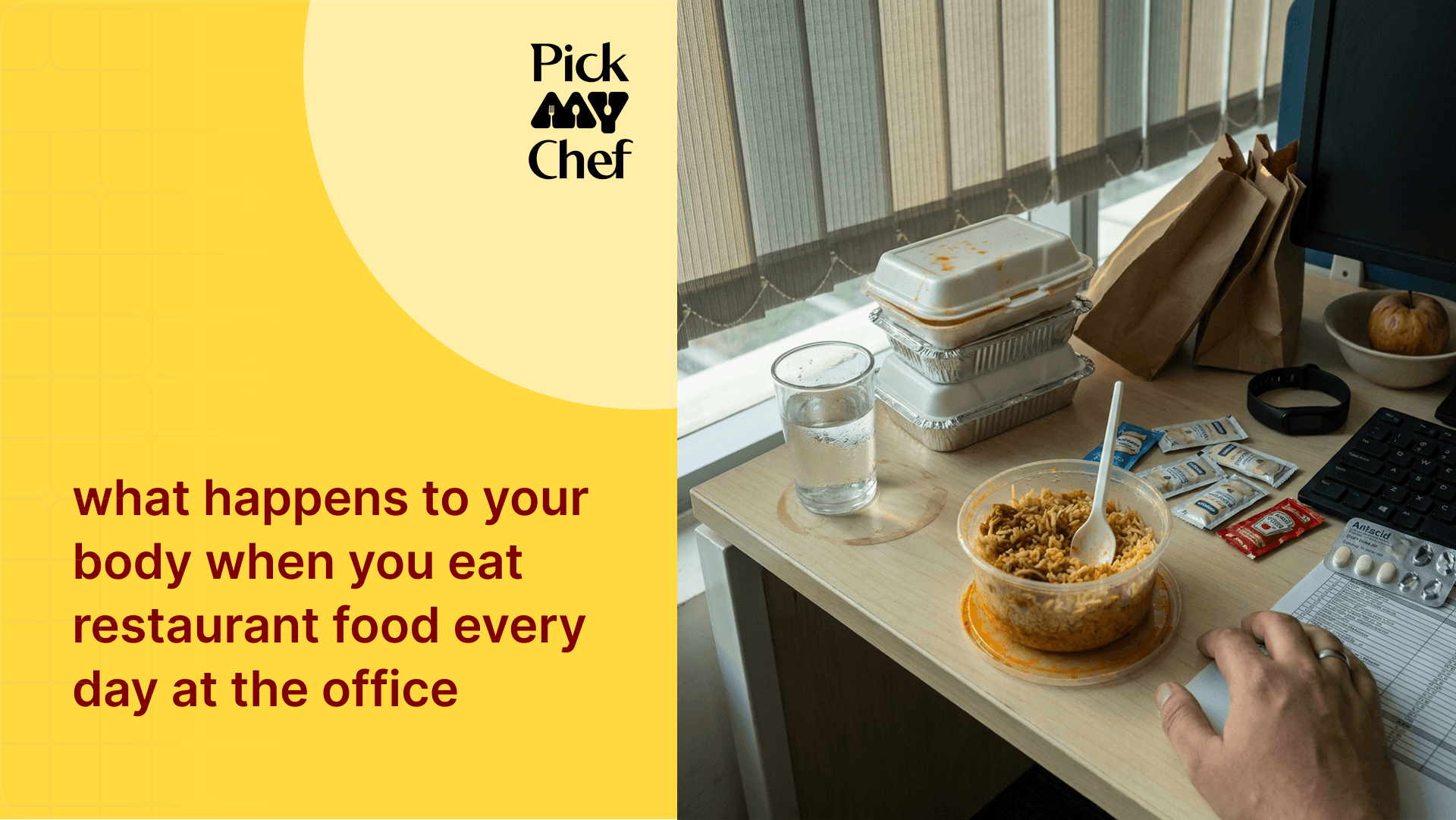
Priya noticed it sometime around month three. Not a dramatic health crisis - nothing that would send her to a doctor. Just a slow, creeping tiredness that settled in every afternoon around 2:30 PM. Her concentration dipped. Her energy flatlined. By 4 PM she was running on black coffee and willpower.
She hadn't changed her sleep schedule. I hadn't taken on more work. The only thing that had changed was that she'd moved to a new office in Kondapur - one without a canteen and had started ordering lunch from a restaurant downstairs every single day.
It took her another two months to connect the dots.
If you're eating restaurant food for lunch five days a week at your Hyderabad office, you're probably not thinking much about it. It's convenient, it's available, and it tastes decent enough. But what is it actually doing to your body over time? The answer is more significant than most people realize — and more fixable than you'd expect.
The Problem Isn't Indian Food. It's How Restaurant Indian Food Is Made.
Let's be precise about this, because there's an important distinction that gets lost in the conversation.
Traditional Indian home cooking — dal, sabzi, roti, rice, sambar — is genuinely one of the healthiest cuisines in the world. Turmeric, cumin, ginger, lentils, fermented foods like curd — these are powerful, anti-inflammatory ingredients that generations of Indians built their health on.
Restaurant Indian food is a different category entirely. Not because the dishes are different, but because of what happens in the kitchen before it reaches your table.
The core issue is oil. Restaurants cook in volume. They use cheap, refined vegetable and seed oils — sunflower, palm, soybeans — because they're inexpensive, have a high smoke point, and keep costs low. These refined oils are high in omega-6 fatty acids. When consumed in excess and regularly, they trigger pro-inflammatory responses in the body. Over weeks and months, this accumulates in ways that are quiet but real: bloating, fatigue, skin issues, and a digestive system that never quite feels settled.
The second issue is sodium. Restaurant food is seasoned for immediate impact — it needs to taste good in the first two bites, not necessarily the next two months. A typical restaurant lunch can contain anywhere from 1,500mg to 2,500mg of sodium. The recommended daily intake for an adult is around 2,300mg in total. In one office lunch, you could be consuming your entire day's sodium allocation — and still have dinner ahead of you.
What Your Body Is Actually Going Through After That Lunch
The first hour: the blood sugar spike
Most restaurant lunches — biryani, a paneer curry with naan, a thali with white rice — are built on refined carbohydrates. These digest rapidly, flooding your bloodstream with glucose. Your blood sugar spikes sharply. You feel a brief, pleasant burst of energy and satiety.
Your brain is consuming roughly 20% of your body's total energy, and it runs on glucose. A sudden spike — followed by the crash that comes 60 to 90 minutes later — is not the smooth fuel your brain wants. It wants steady, consistent glucose, the kind that comes from complex carbohydrates, protein, and fiber.
The 2 PM crash: it has a name, and it's not just tiredness
The energy crash that most office workers experience after a heavy restaurant lunch is not laziness or a bad night's sleep. It's a predictable physiological response. After the glucose spike, your pancreas releases insulin to bring blood sugar back down — often overshooting and driving it below optimal levels. This drop is what creates the brain fog, the difficulty concentrating, and the craving for something sweet or caffeinated.
Employees with unhealthy diets are significantly more likely to report lower productivity compared to those who eat meals built around whole grains, vegetables, and lean protein. The 2 PM slump that feels like a personal failing is, in large part, a lunch problem.
The long game: what happens over months
One restaurant lunch will not hurt you. But the body is a ledger, and it keeps careful accounts.
Chronic inflammation Daily intake of refined oils and processed food ingredients creates low-grade systemic inflammation. This is the kind that doesn't announce itself loudly — it just makes you feel slightly worse than you should. Joints ache a little more. Recovery from illness takes a little longer. Energy stays a little lower than it used to.
Digestive disruption . Restaurant food cooked in large quantities, reheated, and transported typically lacks the live cultures, fibre, and freshness that keep gut bacteria healthy. A compromised gut microbiome affects everything from immunity to mood — the gut-brain axis is a well-documented and increasingly understood connection.
Weight gain that sneaks up Restaurant portion sizes are calibrated for satisfaction, not nutrition. They're bigger than home-cooked portions, higher in fat and refined carbs, and lower in the fiber that creates actual satiety. The body adjusts slowly. The numbers on the scale are adjusted too.
Skin and hair changes Excess refined oil, sodium, and sugar in the diet manifest in skin - increased oiliness, breakouts, and dullness are frequently reported by people who shift from home-cooked to daily restaurant food. These aren't cosmetic trivialities; they're the body's surface-level signals of internal imbalance.
"But the Food Tastes Fine, and I Feel Okay"
This is the most honest objection, and it deserves a direct answer.
The effects described above are cumulative and slow. They don't announce themselves dramatically. The difference between how you feel at month one of daily restaurant food and month six is real, but gradual enough that most people attribute it to work stress, aging, or poor sleep — not to what they're eating at 1 PM.
The test isn't whether you feel bad. It's whether you feel as good as you could.
Most people who shift from daily restaurant lunch to a home-cooked meal subscription report the same pattern: the first week, they notice nothing. By the third week, the 2 PM crash has softened. By the second month, they're surprised to realize they feel consistently better — not dramatically, not overnight, but steadily and undeniably.
The Specific Problem with Hyderabad's Office Lunch Ecosystem
Hyderabad's food delivery market is enormous and genuinely impressive. But it is optimized almost entirely for taste, speed, and cost — not for the nutritional needs of someone who sits at a desk for eight hours and needs to think clearly, focus, and perform.
Biryani — Hyderabad's iconic dish and a favorite office order — is a case study in this gap. The restaurant Biryani is delicious. It is also typically made with refined oil, white rice, and seasoned heavily with salt and spices designed to hit hard and fast. Eating occasionally is one of the great joys of living in this city. Eating every second day for lunch is something your body must work quite hard to manage.
The same applies to the paneer dishes, the fried rice, the hotel thali that seems balanced but arrives having been prepared four hours earlier and reheated twice.
This is not an indictment of Hyderabad's restaurant culture. It's a description of what mass-scale restaurant cooking structurally requires — and why it was never designed to be your daily fuel.
What Actually Works: The Home-Cooked Difference
Here's what changes when you eat at a home-cooked meal instead.
The oil is different. A home chef cooking in small quantities for real people uses measured, appropriate amounts of oil — often better-quality oils like mustard, coconut, or minimal refined oil. Not the industrial quantities poured into a vat at a restaurant's kitchen.
Freshness is different. A meal cooked that morning and delivered by lunch has not been batch-cooked twelve hours ago, transported, reheated, and served. The vitamins are more intact. The texture reflects actual cooking, not reheating.
The portion is different. Home-cooked portions are sized for a meal, not for maximum restaurant satisfaction. They're balanced across protein, carbohydrates, and vegetables in a way that produces steady energy rather than a spike and crash.
The intention is different — and this is harder to quantify but impossible to ignore. A home chef cooking daily for her customers cares about the food in a way that a restaurant kitchen producing 200 covers of the same dish at scale cannot. That care shows up in ingredient quality, in the amount of oil used, in whether the dal is freshly cooked or yesterday's batch.
Five Signs Your Body Is Telling You to Change Your Lunch
You feel a consistent energy dip between 2 and 4 PM every workday
You feel heavy or bloated most afternoons after lunch
You're reaching for coffee or something sweet within 90 minutes of eating
Your skin has become oilier or more prone to breakouts than it used to be
You finish lunch and feel full but not satisfied — like something was missing
Any one of these on its own could have multiple causes. All five together, appearing consistently on workdays and easing on weekends when you eat differently — that pattern is your body telling you something specific.
A Practical Way to Start
You don't have to overhaul your entire diet. Start with one meal.
Replacing your office lunch with a home-cooked meal subscription is the single highest-leverage dietary change most Hyderabad office workers can make. It's the meal where the current default is most problematic, where the alternative is most accessible, and where the impact on your afternoon energy and focus is most immediate.
Pick My Chef's home chef meal subscriptions start at ₹99 per day — less than most restaurant or delivery app lunches — with rotating weekly menus covering South Indian and North Indian options, vegetarian and non-vegetarian, and specific plans for low-calorie or high-protein needs. Every chef is vetted in person and FSSAI registered. The food arrives fresh, cooked that morning, by a real person who made it for you.
It's not a dramatic lifestyle change. It's just choosing, once a day, to eat the way your body was designed to be fed.
Your 2 PM self will notice the difference within two weeks.
What Happens to Your Body When You Eat Restaurant Food Every Day at the Office
Ordering from Zomato or the hotel downstairs every single day? Here's the honest, science-backed truth about what daily restaurant food does to your body — and what to do instead.
Priya noticed it sometime around month three. Not a dramatic health crisis - nothing that would send her to a doctor. Just a slow, creeping tiredness that settled in every afternoon around 2:30 PM. Her concentration dipped. Her energy flatlined. By 4 PM she was running on black coffee and willpower.
She hadn't changed her sleep schedule. I hadn't taken on more work. The only thing that had changed was that she'd moved to a new office in Kondapur - one without a canteen and had started ordering lunch from a restaurant downstairs every single day.
It took her another two months to connect the dots.
If you're eating restaurant food for lunch five days a week at your Hyderabad office, you're probably not thinking much about it. It's convenient, it's available, and it tastes decent enough. But what is it actually doing to your body over time? The answer is more significant than most people realize — and more fixable than you'd expect.
The Problem Isn't Indian Food. It's How Restaurant Indian Food Is Made.
Let's be precise about this, because there's an important distinction that gets lost in the conversation.
Traditional Indian home cooking — dal, sabzi, roti, rice, sambar — is genuinely one of the healthiest cuisines in the world. Turmeric, cumin, ginger, lentils, fermented foods like curd — these are powerful, anti-inflammatory ingredients that generations of Indians built their health on.
Restaurant Indian food is a different category entirely. Not because the dishes are different, but because of what happens in the kitchen before it reaches your table.
The core issue is oil. Restaurants cook in volume. They use cheap, refined vegetable and seed oils — sunflower, palm, soybeans — because they're inexpensive, have a high smoke point, and keep costs low. These refined oils are high in omega-6 fatty acids. When consumed in excess and regularly, they trigger pro-inflammatory responses in the body. Over weeks and months, this accumulates in ways that are quiet but real: bloating, fatigue, skin issues, and a digestive system that never quite feels settled.
The second issue is sodium. Restaurant food is seasoned for immediate impact — it needs to taste good in the first two bites, not necessarily the next two months. A typical restaurant lunch can contain anywhere from 1,500mg to 2,500mg of sodium. The recommended daily intake for an adult is around 2,300mg in total. In one office lunch, you could be consuming your entire day's sodium allocation — and still have dinner ahead of you.
What Your Body Is Actually Going Through After That Lunch
The first hour: the blood sugar spike
Most restaurant lunches — biryani, a paneer curry with naan, a thali with white rice — are built on refined carbohydrates. These digest rapidly, flooding your bloodstream with glucose. Your blood sugar spikes sharply. You feel a brief, pleasant burst of energy and satiety.
Your brain is consuming roughly 20% of your body's total energy, and it runs on glucose. A sudden spike — followed by the crash that comes 60 to 90 minutes later — is not the smooth fuel your brain wants. It wants steady, consistent glucose, the kind that comes from complex carbohydrates, protein, and fiber.
The 2 PM crash: it has a name, and it's not just tiredness
The energy crash that most office workers experience after a heavy restaurant lunch is not laziness or a bad night's sleep. It's a predictable physiological response. After the glucose spike, your pancreas releases insulin to bring blood sugar back down — often overshooting and driving it below optimal levels. This drop is what creates the brain fog, the difficulty concentrating, and the craving for something sweet or caffeinated.
Employees with unhealthy diets are significantly more likely to report lower productivity compared to those who eat meals built around whole grains, vegetables, and lean protein. The 2 PM slump that feels like a personal failing is, in large part, a lunch problem.
The long game: what happens over months
One restaurant lunch will not hurt you. But the body is a ledger, and it keeps careful accounts.
Chronic inflammation Daily intake of refined oils and processed food ingredients creates low-grade systemic inflammation. This is the kind that doesn't announce itself loudly — it just makes you feel slightly worse than you should. Joints ache a little more. Recovery from illness takes a little longer. Energy stays a little lower than it used to.
Digestive disruption . Restaurant food cooked in large quantities, reheated, and transported typically lacks the live cultures, fibre, and freshness that keep gut bacteria healthy. A compromised gut microbiome affects everything from immunity to mood — the gut-brain axis is a well-documented and increasingly understood connection.
Weight gain that sneaks up Restaurant portion sizes are calibrated for satisfaction, not nutrition. They're bigger than home-cooked portions, higher in fat and refined carbs, and lower in the fiber that creates actual satiety. The body adjusts slowly. The numbers on the scale are adjusted too.
Skin and hair changes Excess refined oil, sodium, and sugar in the diet manifest in skin - increased oiliness, breakouts, and dullness are frequently reported by people who shift from home-cooked to daily restaurant food. These aren't cosmetic trivialities; they're the body's surface-level signals of internal imbalance.
"But the Food Tastes Fine, and I Feel Okay"
This is the most honest objection, and it deserves a direct answer.
The effects described above are cumulative and slow. They don't announce themselves dramatically. The difference between how you feel at month one of daily restaurant food and month six is real, but gradual enough that most people attribute it to work stress, aging, or poor sleep — not to what they're eating at 1 PM.
The test isn't whether you feel bad. It's whether you feel as good as you could.
Most people who shift from daily restaurant lunch to a home-cooked meal subscription report the same pattern: the first week, they notice nothing. By the third week, the 2 PM crash has softened. By the second month, they're surprised to realize they feel consistently better — not dramatically, not overnight, but steadily and undeniably.
The Specific Problem with Hyderabad's Office Lunch Ecosystem
Hyderabad's food delivery market is enormous and genuinely impressive. But it is optimized almost entirely for taste, speed, and cost — not for the nutritional needs of someone who sits at a desk for eight hours and needs to think clearly, focus, and perform.
Biryani — Hyderabad's iconic dish and a favorite office order — is a case study in this gap. The restaurant Biryani is delicious. It is also typically made with refined oil, white rice, and seasoned heavily with salt and spices designed to hit hard and fast. Eating occasionally is one of the great joys of living in this city. Eating every second day for lunch is something your body must work quite hard to manage.
The same applies to the paneer dishes, the fried rice, the hotel thali that seems balanced but arrives having been prepared four hours earlier and reheated twice.
This is not an indictment of Hyderabad's restaurant culture. It's a description of what mass-scale restaurant cooking structurally requires — and why it was never designed to be your daily fuel.
What Actually Works: The Home-Cooked Difference
Here's what changes when you eat at a home-cooked meal instead.
The oil is different. A home chef cooking in small quantities for real people uses measured, appropriate amounts of oil — often better-quality oils like mustard, coconut, or minimal refined oil. Not the industrial quantities poured into a vat at a restaurant's kitchen.
Freshness is different. A meal cooked that morning and delivered by lunch has not been batch-cooked twelve hours ago, transported, reheated, and served. The vitamins are more intact. The texture reflects actual cooking, not reheating.
The portion is different. Home-cooked portions are sized for a meal, not for maximum restaurant satisfaction. They're balanced across protein, carbohydrates, and vegetables in a way that produces steady energy rather than a spike and crash.
The intention is different — and this is harder to quantify but impossible to ignore. A home chef cooking daily for her customers cares about the food in a way that a restaurant kitchen producing 200 covers of the same dish at scale cannot. That care shows up in ingredient quality, in the amount of oil used, in whether the dal is freshly cooked or yesterday's batch.
Five Signs Your Body Is Telling You to Change Your Lunch
You feel a consistent energy dip between 2 and 4 PM every workday
You feel heavy or bloated most afternoons after lunch
You're reaching for coffee or something sweet within 90 minutes of eating
Your skin has become oilier or more prone to breakouts than it used to be
You finish lunch and feel full but not satisfied — like something was missing
Any one of these on its own could have multiple causes. All five together, appearing consistently on workdays and easing on weekends when you eat differently — that pattern is your body telling you something specific.
A Practical Way to Start
You don't have to overhaul your entire diet. Start with one meal.
Replacing your office lunch with a home-cooked meal subscription is the single highest-leverage dietary change most Hyderabad office workers can make. It's the meal where the current default is most problematic, where the alternative is most accessible, and where the impact on your afternoon energy and focus is most immediate.
Pick My Chef's home chef meal subscriptions start at ₹99 per day — less than most restaurant or delivery app lunches — with rotating weekly menus covering South Indian and North Indian options, vegetarian and non-vegetarian, and specific plans for low-calorie or high-protein needs. Every chef is vetted in person and FSSAI registered. The food arrives fresh, cooked that morning, by a real person who made it for you.
It's not a dramatic lifestyle change. It's just choosing, once a day, to eat the way your body was designed to be fed.
Your 2 PM self will notice the difference within two weeks.
What Happens to Your Body When You Eat Restaurant Food Every Day at the Office
Ordering from Zomato or the hotel downstairs every single day? Here's the honest, science-backed truth about what daily restaurant food does to your body — and what to do instead.
Priya noticed it sometime around month three. Not a dramatic health crisis - nothing that would send her to a doctor. Just a slow, creeping tiredness that settled in every afternoon around 2:30 PM. Her concentration dipped. Her energy flatlined. By 4 PM she was running on black coffee and willpower.
She hadn't changed her sleep schedule. I hadn't taken on more work. The only thing that had changed was that she'd moved to a new office in Kondapur - one without a canteen and had started ordering lunch from a restaurant downstairs every single day.
It took her another two months to connect the dots.
If you're eating restaurant food for lunch five days a week at your Hyderabad office, you're probably not thinking much about it. It's convenient, it's available, and it tastes decent enough. But what is it actually doing to your body over time? The answer is more significant than most people realize — and more fixable than you'd expect.
The Problem Isn't Indian Food. It's How Restaurant Indian Food Is Made.
Let's be precise about this, because there's an important distinction that gets lost in the conversation.
Traditional Indian home cooking — dal, sabzi, roti, rice, sambar — is genuinely one of the healthiest cuisines in the world. Turmeric, cumin, ginger, lentils, fermented foods like curd — these are powerful, anti-inflammatory ingredients that generations of Indians built their health on.
Restaurant Indian food is a different category entirely. Not because the dishes are different, but because of what happens in the kitchen before it reaches your table.
The core issue is oil. Restaurants cook in volume. They use cheap, refined vegetable and seed oils — sunflower, palm, soybeans — because they're inexpensive, have a high smoke point, and keep costs low. These refined oils are high in omega-6 fatty acids. When consumed in excess and regularly, they trigger pro-inflammatory responses in the body. Over weeks and months, this accumulates in ways that are quiet but real: bloating, fatigue, skin issues, and a digestive system that never quite feels settled.
The second issue is sodium. Restaurant food is seasoned for immediate impact — it needs to taste good in the first two bites, not necessarily the next two months. A typical restaurant lunch can contain anywhere from 1,500mg to 2,500mg of sodium. The recommended daily intake for an adult is around 2,300mg in total. In one office lunch, you could be consuming your entire day's sodium allocation — and still have dinner ahead of you.
What Your Body Is Actually Going Through After That Lunch
The first hour: the blood sugar spike
Most restaurant lunches — biryani, a paneer curry with naan, a thali with white rice — are built on refined carbohydrates. These digest rapidly, flooding your bloodstream with glucose. Your blood sugar spikes sharply. You feel a brief, pleasant burst of energy and satiety.
Your brain is consuming roughly 20% of your body's total energy, and it runs on glucose. A sudden spike — followed by the crash that comes 60 to 90 minutes later — is not the smooth fuel your brain wants. It wants steady, consistent glucose, the kind that comes from complex carbohydrates, protein, and fiber.
The 2 PM crash: it has a name, and it's not just tiredness
The energy crash that most office workers experience after a heavy restaurant lunch is not laziness or a bad night's sleep. It's a predictable physiological response. After the glucose spike, your pancreas releases insulin to bring blood sugar back down — often overshooting and driving it below optimal levels. This drop is what creates the brain fog, the difficulty concentrating, and the craving for something sweet or caffeinated.
Employees with unhealthy diets are significantly more likely to report lower productivity compared to those who eat meals built around whole grains, vegetables, and lean protein. The 2 PM slump that feels like a personal failing is, in large part, a lunch problem.
The long game: what happens over months
One restaurant lunch will not hurt you. But the body is a ledger, and it keeps careful accounts.
Chronic inflammation Daily intake of refined oils and processed food ingredients creates low-grade systemic inflammation. This is the kind that doesn't announce itself loudly — it just makes you feel slightly worse than you should. Joints ache a little more. Recovery from illness takes a little longer. Energy stays a little lower than it used to.
Digestive disruption . Restaurant food cooked in large quantities, reheated, and transported typically lacks the live cultures, fibre, and freshness that keep gut bacteria healthy. A compromised gut microbiome affects everything from immunity to mood — the gut-brain axis is a well-documented and increasingly understood connection.
Weight gain that sneaks up Restaurant portion sizes are calibrated for satisfaction, not nutrition. They're bigger than home-cooked portions, higher in fat and refined carbs, and lower in the fiber that creates actual satiety. The body adjusts slowly. The numbers on the scale are adjusted too.
Skin and hair changes Excess refined oil, sodium, and sugar in the diet manifest in skin - increased oiliness, breakouts, and dullness are frequently reported by people who shift from home-cooked to daily restaurant food. These aren't cosmetic trivialities; they're the body's surface-level signals of internal imbalance.
"But the Food Tastes Fine, and I Feel Okay"
This is the most honest objection, and it deserves a direct answer.
The effects described above are cumulative and slow. They don't announce themselves dramatically. The difference between how you feel at month one of daily restaurant food and month six is real, but gradual enough that most people attribute it to work stress, aging, or poor sleep — not to what they're eating at 1 PM.
The test isn't whether you feel bad. It's whether you feel as good as you could.
Most people who shift from daily restaurant lunch to a home-cooked meal subscription report the same pattern: the first week, they notice nothing. By the third week, the 2 PM crash has softened. By the second month, they're surprised to realize they feel consistently better — not dramatically, not overnight, but steadily and undeniably.
The Specific Problem with Hyderabad's Office Lunch Ecosystem
Hyderabad's food delivery market is enormous and genuinely impressive. But it is optimized almost entirely for taste, speed, and cost — not for the nutritional needs of someone who sits at a desk for eight hours and needs to think clearly, focus, and perform.
Biryani — Hyderabad's iconic dish and a favorite office order — is a case study in this gap. The restaurant Biryani is delicious. It is also typically made with refined oil, white rice, and seasoned heavily with salt and spices designed to hit hard and fast. Eating occasionally is one of the great joys of living in this city. Eating every second day for lunch is something your body must work quite hard to manage.
The same applies to the paneer dishes, the fried rice, the hotel thali that seems balanced but arrives having been prepared four hours earlier and reheated twice.
This is not an indictment of Hyderabad's restaurant culture. It's a description of what mass-scale restaurant cooking structurally requires — and why it was never designed to be your daily fuel.
What Actually Works: The Home-Cooked Difference
Here's what changes when you eat at a home-cooked meal instead.
The oil is different. A home chef cooking in small quantities for real people uses measured, appropriate amounts of oil — often better-quality oils like mustard, coconut, or minimal refined oil. Not the industrial quantities poured into a vat at a restaurant's kitchen.
Freshness is different. A meal cooked that morning and delivered by lunch has not been batch-cooked twelve hours ago, transported, reheated, and served. The vitamins are more intact. The texture reflects actual cooking, not reheating.
The portion is different. Home-cooked portions are sized for a meal, not for maximum restaurant satisfaction. They're balanced across protein, carbohydrates, and vegetables in a way that produces steady energy rather than a spike and crash.
The intention is different — and this is harder to quantify but impossible to ignore. A home chef cooking daily for her customers cares about the food in a way that a restaurant kitchen producing 200 covers of the same dish at scale cannot. That care shows up in ingredient quality, in the amount of oil used, in whether the dal is freshly cooked or yesterday's batch.
Five Signs Your Body Is Telling You to Change Your Lunch
You feel a consistent energy dip between 2 and 4 PM every workday
You feel heavy or bloated most afternoons after lunch
You're reaching for coffee or something sweet within 90 minutes of eating
Your skin has become oilier or more prone to breakouts than it used to be
You finish lunch and feel full but not satisfied — like something was missing
Any one of these on its own could have multiple causes. All five together, appearing consistently on workdays and easing on weekends when you eat differently — that pattern is your body telling you something specific.
A Practical Way to Start
You don't have to overhaul your entire diet. Start with one meal.
Replacing your office lunch with a home-cooked meal subscription is the single highest-leverage dietary change most Hyderabad office workers can make. It's the meal where the current default is most problematic, where the alternative is most accessible, and where the impact on your afternoon energy and focus is most immediate.
Pick My Chef's home chef meal subscriptions start at ₹99 per day — less than most restaurant or delivery app lunches — with rotating weekly menus covering South Indian and North Indian options, vegetarian and non-vegetarian, and specific plans for low-calorie or high-protein needs. Every chef is vetted in person and FSSAI registered. The food arrives fresh, cooked that morning, by a real person who made it for you.
It's not a dramatic lifestyle change. It's just choosing, once a day, to eat the way your body was designed to be fed.
Your 2 PM self will notice the difference within two weeks.
Get App